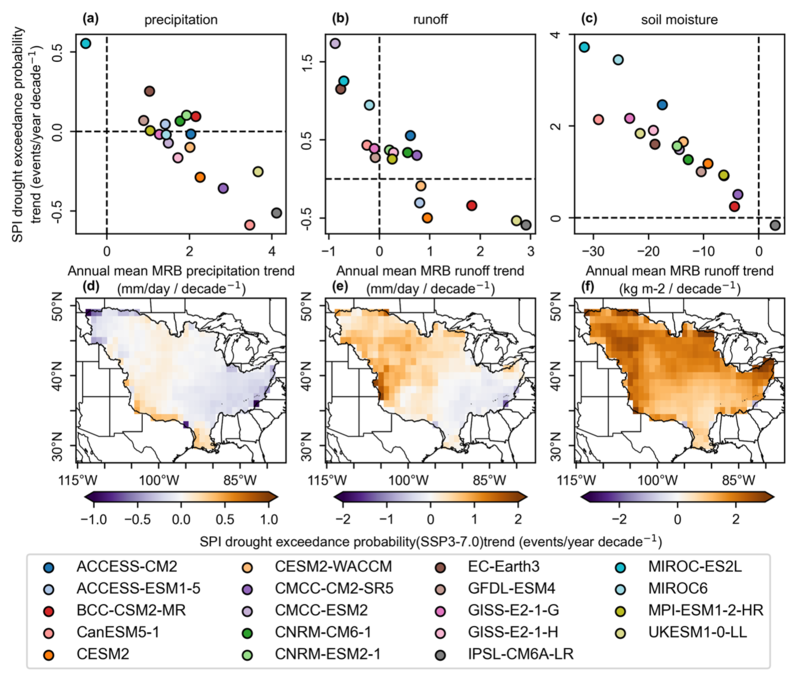
Abstract The Mississippi River system drains 41% of the contiguous United States and is heavily engineered to mitigate hydrological extremes and facilitate commerce. However, future changes to water availability in the region are uncertain and may threaten the existing management systems. In this study, 19 models from Coupled Model Intercomparison Project phase 6 (CMIP6) are validated against historical observations and examined to understand monthly hydroclimate changes using the shared socioeconomic pathway 3-7.0 (SSP3-7.0) pathway. Models agree that precipitation will increase throughout the Mississippi River basin, but soil moisture will decrease in all seasons due to increasing evaporative demand. Precipitation minus evapotranspiration ( P − ET), runoff, and discharge simulated by river transport models are poorly constrained with differing trends between regions and models. Generally, models agree that runoff increases are more robust for the eastern subbasins, where precipitation anomalies are higher, and drying trends are more likely for the Missouri River subbasin. Models projecting increased runoff within the Mississippi River basin show stronger ENSO-related Pacific warming, enhanced North Atlantic subtropical high development, and increased moisture transport into the Ohio subbasin. In contrast, drying models exhibit weaker Pacific warming and circulation changes, with precipitation and runoff declines concentrated in the western tributaries. These results highlight the role of large-scale atmospheric and oceanic drivers in shaping divergent hydroclimate projections for the Mississippi River basin. Significance Statement Projections of future hydroclimate in the Mississippi River basin, the largest in North America, remain uncertain despite its critical role for agriculture and commerce. Using an ensemble of 19 models, this study provides the first comprehensive CMIP6 assessment of twenty-first-century hydrological trends across the basin. Our results reveal that precipitation will increase throughout the basin, particularly during winter and spring, and in the Ohio River subbasin. Total runoff projections are less certain, but climate models agree that discharge will increase in the Ohio and decrease in the Missouri subbasins. Water management strategies must consider this longitudinal pattern, as infrastructure built for twentieth-century conditions may face increasing risk from both high-flow and low-flow extremes in different portions of the basin.
BibTeX
@article{hancock_mississippitrends:2026,
  url = {https://doi.org/10.1175/jcli-d-25-0340.1},
  doi = {10.1175/jcli-d-25-0340.1},
  publisher = {American Meteorological Society},
  pages = {2263--2280},
  number = {9},
  volume = {39},
  shortjournal = {J. Clim.},
  journaltitle = {Journal of Climate},
  date = {2026-05-01},
  author = {Hancock, Christopher L. and Dee, Sylvia G. and Haider, Muhammad Rezaul and Doss-Gollin, James and Lehner, Flavio and Murphy, Kelsey and Muñoz, Samuel E.},
  shorttitle = {Mississippi Trends},
  title = {Twenty-{{First-Century Hydrological Trends}} in the {{Mississippi River Basin Intensify}} the {{East}}–{{West Moisture Gradient}}},
}