Congratulations, Dr. Yuchen Lu!
We are tremendously proud of Dr. Yuchen Lu, who defended her PhD thesis, “Probabilistic Analysis of Nonstationary Hydroclimate Extremes,” on July 15, 2026 in Ryon Lab 112.
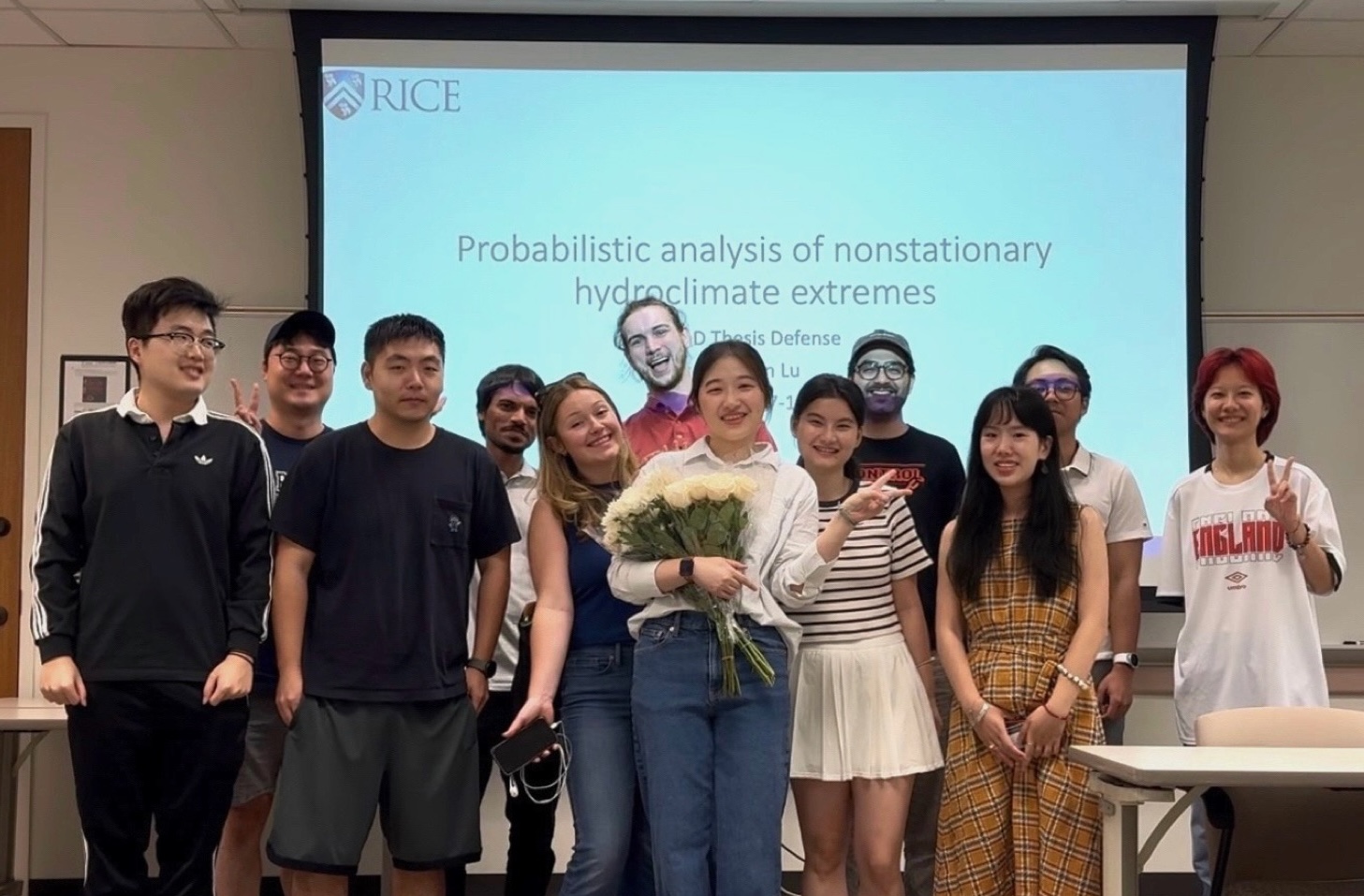
Yuchen’s dissertation develops statistical frameworks for estimating rainfall and tropical cyclone probabilities that change over time. Standard engineering practice assumes these probabilities are fixed, and relaxing that assumption is hard when records of rare events are short and unevenly distributed in space. Her methods address that problem, and they give engineers a more defensible basis for infrastructure design and adaptation planning.
Thanks to her committee members Dr. Philip Bedient, Dr. Avantika Gori, and Dr. Katherine Ensor for their guidance and feedback, and to her friends, funders, and teachers for their support.
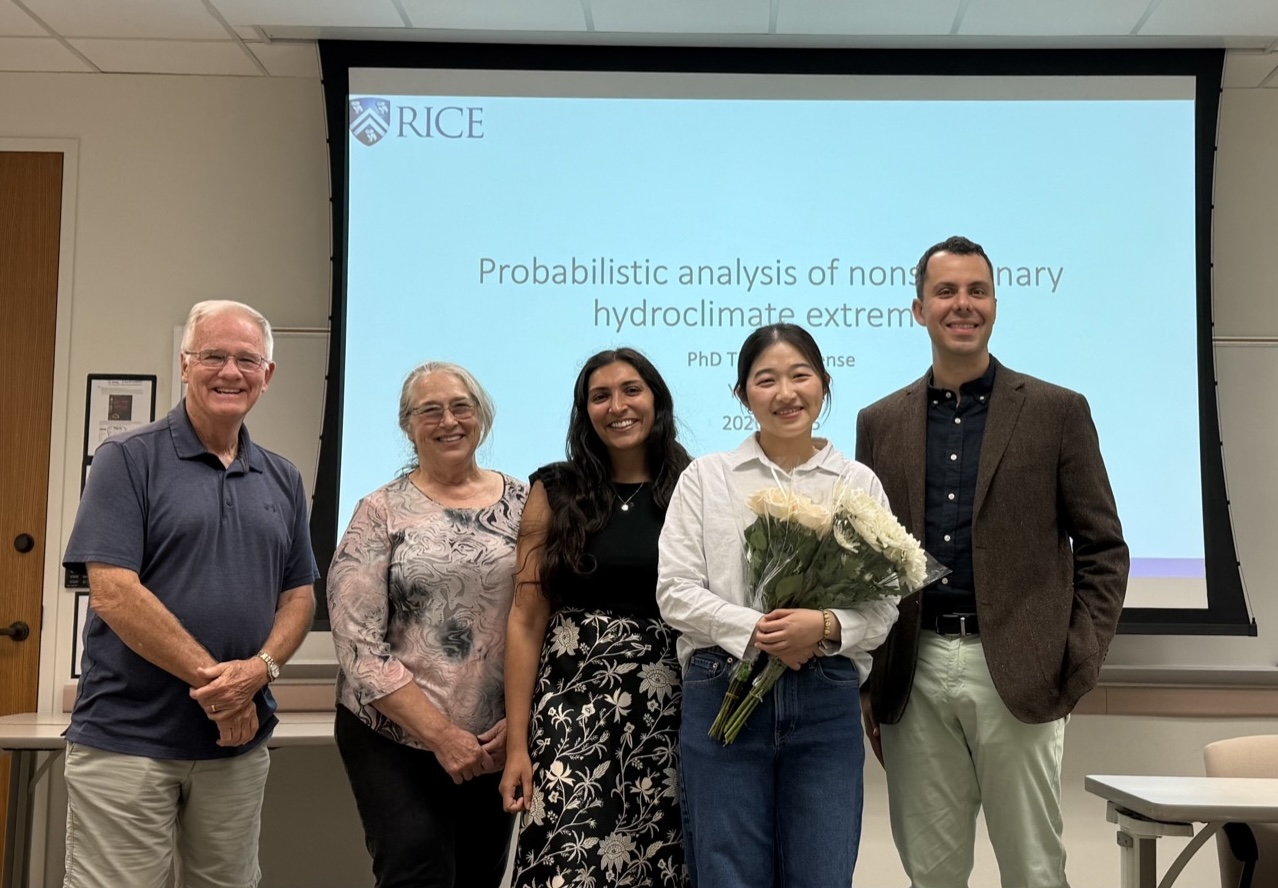

Congratulations, Dr. Lu!
Abstract
Hydroclimate extremes, including extreme rainfall and tropical cyclones, pose substantial threats to communities, infrastructure systems, and ecosystems. Probabilistic characterization of these extremes is essential for risk assessment, infrastructure design, and climate adaptation. Many commonly used approaches for estimating hydroclimate hazards assume stationarity, even though observations and climate projections show that they are influenced by climate variability and long-term climate change. However, accounting for this nonstationarity is challenging because observations of rare events are sparse in time and space, while climate model products contain systematic biases. To address these, this dissertation develops statistical frameworks that incorporate nonstationarity into probabilistic analyses of hydroclimate extremes using limited observational records. The first study develops a hierarchical Bayesian space-time framework for nonstationary analysis of extreme rainfall probabilities. By incorporating time-varying climate covariates and spatial pooling, the framework reduces sampling variability and estimates spatially coherent changes in daily rainfall extremes. The second chapter extends this analysis to multi-duration rainfall frequency estimates by incorporating duration dependence. This work addresses the challenge of maintaining coherence across both space and durations. The third chapter develops a nonstationary joint probability framework for characterizing tropical cyclone parameters relevant to hazard analysis. This approach mitigates the challenge of limited local records by using regional changes in storm characteristics to inform local-scale analyses. Together, these three studies address a common problem in hydroclimate risk analysis: how to estimate changing extremes from limited and spatially heterogeneous observations. Across rainfall and tropical cyclone applications, the proposed frameworks improve the stability, spatial coherence, and physical interpretability of nonstationary hazard estimates. These methods provide a basis for more robust infrastructure design and climate adaptation planning under changing hydroclimate risk.