Code
using ICOW
using ICOW.EAD
using Random
using CairoMakie
CairoMakie.activate!(; type="svg")Your First iCOW Analysis
This tutorial walks through a complete flood risk analysis using ICOW.jl. By the end, you will have configured a coastal city, tried several protection strategies, and compared their investment-vs-damage tradeoffs.
using ICOW
using ICOW.EAD
using Random
using CairoMakie
CairoMakie.activate!(; type="svg")Imagine you are advising a coastal city on flood protection investments. The city sits on a wedge of land that rises from sea level to \(H_{\text{city}} = 17\) meters. It has a short existing seawall, but major storm surges can overtop it and cause serious damage.
You need to answer: what combination of withdrawal, resistance, and dikes should the city invest in?
An EADConfig holds the 28 physical and economic parameters that define the city. The defaults describe a Manhattan-like setting.
config = EADConfig()EADConfig{Float64}(1.5e12, 30.0, 17.0, 2000.0, 43000.0, 1.75, 2.0, 3.0, 0.5, 1000.0, 1.1, 0.95, 1.0, 0.01, 1.25, 0.35, 0.115, 0.4, 3.0, 0.39, 0.03, 1.5, 0.95, 0.05, 1.1, 4.0e9, 1.0, 1.01, 100, QuadratureIntegrator{Float64}(1.0e-6))The most important parameters to understand are:
| Parameter | Value | What It Means |
|---|---|---|
V_city |
$1.5T | Total value of all buildings and infrastructure |
H_city |
17.0 m | Elevation from waterfront to highest point |
H_seawall |
1.75 m | Existing seawall height (surges below this cause no flooding) |
H_bldg |
30.0 m | Average building height (normalizes resistance costs) |
You can customize any parameter:
# A smaller, lower-lying city
config_small = EADConfig(; V_city=5e11, H_city=10.0, H_seawall=1.0)
EADConfig{Float64}(5.0e11, 30.0, 10.0, 2000.0, 43000.0, 1.0, 2.0, 3.0, 0.5, 1000.0, 1.1, 0.95, 1.0, 0.01, 1.25, 0.35, 0.115, 0.4, 3.0, 0.39, 0.03, 1.5, 0.95, 0.05, 1.1, 4.0e9, 1.0, 1.01, 100, QuadratureIntegrator{Float64}(1.0e-6))For this tutorial, we will use the defaults.
Storm surge heights follow a Generalized Extreme Value (GEV) distribution, which is the natural statistical model for annual maxima. An EADScenario specifies the GEV parameters, a discount rate, and a mean sea level time series (which can represent sea level rise):
n_years = config.n_years
scenario = EADScenario(;
    surge_loc=0.935,      # GEV location (m): calibrated to The Battery, NYC
    surge_scale=0.260,    # GEV scale (m)
    surge_shape=0.030,    # GEV shape: slightly heavy-tailed
    discount_rate=0.02,   # 2% annual discount rate
    mean_sea_level=collect(range(0.0; step=0.01, length=n_years)),  # 1 cm/yr SLR
)
EADScenario{Float64}(SimOptDecisions.ContinuousParameter{Float64}(0.935, (-5.0, 30.0)), SimOptDecisions.ContinuousParameter{Float64}(0.26, (0.01, 20.0)), SimOptDecisions.ContinuousParameter{Float64}(0.03, (-1.0, 1.0)), SimOptDecisions.ContinuousParameter{Float64}(0.02, (0.0, 1.0)), SimOptDecisions.TimeSeriesParameter{Float64, Int64}([1, 2, 3, 4, 5, 6, 7, 8, 9, 10 … 91, 92, 93, 94, 95, 96, 97, 98, 99, 100], [0.0, 0.01, 0.02, 0.03, 0.04, 0.05, 0.06, 0.07, 0.08, 0.09 … 0.9, 0.91, 0.92, 0.93, 0.94, 0.95, 0.96, 0.97, 0.98, 0.99]))The shape parameter controls the tail behavior:
shape = 0: Gumbel distribution (light-tailed, exponential decay)shape > 0: Frechet distribution (heavy-tailed, more extreme surges possible)shape < 0: Weibull distribution (bounded upper tail)For most coastal locations, the shape parameter is near zero or slightly positive.
A StaticPolicy specifies how to allocate protection using five fractions, all between 0 and 1. The “stick-breaking” parameterization guarantees that all physical constraints are satisfied automatically (see Architecture for details).
Let’s try a strategy that invests in a moderate dike with some resistance:
policy_mixed = StaticPolicy(;
    a_frac=0.3,   # use 30% of city elevation as protection budget
    w_frac=0.1,   # 10% of budget goes to withdrawal
    b_frac=0.2,   # 20% of remaining budget goes to dike base
    r_frac=0.1,   # resistance height = 10% of H_city
    P=0.5,        # flood-proof 50% of buildings
)
StaticPolicy{Float64}(SimOptDecisions.ContinuousParameter{Float64}(0.3, (0.0, 1.0)), SimOptDecisions.ContinuousParameter{Float64}(0.1, (0.0, 1.0)), SimOptDecisions.ContinuousParameter{Float64}(0.2, (0.0, 1.0)), SimOptDecisions.ContinuousParameter{Float64}(0.1, (0.0, 1.0)), SimOptDecisions.ContinuousParameter{Float64}(0.5, (0.0, 0.99)))What does this translate to in meters? The policy converts to a FloodDefenses struct:
fd = FloodDefenses(policy_mixed, config)
fd
FloodDefenses(W=0.51m, R=1.7000000000000002m, P=50.0%, D=3.6719999999999997m, B=0.918m)The simulate function computes the total investment cost and expected flood damage over the planning horizon (100 years by default), discounted to present value:
rng = MersenneTwister(42)
outcome = simulate(config, scenario, policy_mixed, rng)
outcome
EADOutcome{Float64}(SimOptDecisions.ContinuousParameter{Float64}(5.455527272132463e10, (-Inf, Inf)), SimOptDecisions.ContinuousParameter{Float64}(2.1096777425625317e9, (-Inf, Inf)))The outcome tells you the present-value investment cost and expected damage. The total cost is their sum:
total_cost(outcome)5.666495046388716e10One strategy is not enough – you need to compare alternatives. Here are five archetypes ranging from “do nothing” to “heavy investment”:
strategies = [
    ("No additional protection", StaticPolicy(; a_frac=0.0, w_frac=0.0, b_frac=0.0, r_frac=0.0, P=0.0)),
    ("Dike only",                StaticPolicy(; a_frac=0.5, w_frac=0.0, b_frac=0.0, r_frac=0.0, P=0.0)),
    ("Withdraw + resist",        StaticPolicy(; a_frac=0.2, w_frac=0.5, b_frac=1.0, r_frac=0.3, P=0.7)),
    ("Mixed",                    StaticPolicy(; a_frac=0.3, w_frac=0.1, b_frac=0.2, r_frac=0.1, P=0.5)),
    ("High dike + resist",       StaticPolicy(; a_frac=0.5, w_frac=0.0, b_frac=0.1, r_frac=0.1, P=0.3)),
]
policy_list = last.(strategies)
strategy_names = first.(strategies)
5-element Vector{String}:
"No additional protection"
"Dike only"
"Withdraw + resist"
"Mixed"
"High dike + resist"The explore() function evaluates all policies against a scenario in one call and returns a structured dataset:
result = explore(config, [scenario], policy_list; progress=false)YAXArray Dataset Shared Axes: None Variables with additional axes: Additional Axes: (↓ policy Sampled{Int64} 1:5 ForwardOrdered Regular Points, → scenario Sampled{Int64} 1:1 ForwardOrdered Regular Points) Variables: expected_damage, investment Additional Axes: (↓ policy Sampled{Int64} 1:5 ForwardOrdered Regular Points) Variables: policy_P, policy_a_frac, policy_b_frac, policy_r_frac, policy_w_frac Additional Axes: (↓ scenario Sampled{Int64} 1:1 ForwardOrdered Regular Points) Variables: scenario_discount_rate, scenario_mean_sea_level[100], scenario_mean_sea_level[10], scenario_mean_sea_level[11], scenario_mean_sea_level[12], scenario_mean_sea_level[13], scenario_mean_sea_level[14], scenario_mean_sea_level[15], scenario_mean_sea_level[16], scenario_mean_sea_level[17], scenario_mean_sea_level[18], scenario_mean_sea_level[19], scenario_mean_sea_level[1], scenario_mean_sea_level[20], scenario_mean_sea_level[21], scenario_mean_sea_level[22], scenario_mean_sea_level[23], scenario_mean_sea_level[24], scenario_mean_sea_level[25], scenario_mean_sea_level[26], scenario_mean_sea_level[27], scenario_mean_sea_level[28], scenario_mean_sea_level[29], scenario_mean_sea_level[2], scenario_mean_sea_level[30], scenario_mean_sea_level[31], scenario_mean_sea_level[32], scenario_mean_sea_level[33], scenario_mean_sea_level[34], scenario_mean_sea_level[35], scenario_mean_sea_level[36], scenario_mean_sea_level[37], scenario_mean_sea_level[38], scenario_mean_sea_level[39], scenario_mean_sea_level[3], scenario_mean_sea_level[40], scenario_mean_sea_level[41], scenario_mean_sea_level[42], scenario_mean_sea_level[43], scenario_mean_sea_level[44], scenario_mean_sea_level[45], scenario_mean_sea_level[46], scenario_mean_sea_level[47], scenario_mean_sea_level[48], scenario_mean_sea_level[49], scenario_mean_sea_level[4], scenario_mean_sea_level[50], scenario_mean_sea_level[51], scenario_mean_sea_level[52], scenario_mean_sea_level[53], scenario_mean_sea_level[54], scenario_mean_sea_level[55], scenario_mean_sea_level[56], scenario_mean_sea_level[57], scenario_mean_sea_level[58], scenario_mean_sea_level[59], scenario_mean_sea_level[5], scenario_mean_sea_level[60], scenario_mean_sea_level[61], scenario_mean_sea_level[62], scenario_mean_sea_level[63], scenario_mean_sea_level[64], scenario_mean_sea_level[65], scenario_mean_sea_level[66], scenario_mean_sea_level[67], scenario_mean_sea_level[68], scenario_mean_sea_level[69], scenario_mean_sea_level[6], scenario_mean_sea_level[70], scenario_mean_sea_level[71], scenario_mean_sea_level[72], scenario_mean_sea_level[73], scenario_mean_sea_level[74], scenario_mean_sea_level[75], scenario_mean_sea_level[76], scenario_mean_sea_level[77], scenario_mean_sea_level[78], scenario_mean_sea_level[79], scenario_mean_sea_level[7], scenario_mean_sea_level[80], scenario_mean_sea_level[81], scenario_mean_sea_level[82], scenario_mean_sea_level[83], scenario_mean_sea_level[84], scenario_mean_sea_level[85], scenario_mean_sea_level[86], scenario_mean_sea_level[87], scenario_mean_sea_level[88], scenario_mean_sea_level[89], scenario_mean_sea_level[8], scenario_mean_sea_level[90], scenario_mean_sea_level[91], scenario_mean_sea_level[92], scenario_mean_sea_level[93], scenario_mean_sea_level[94], scenario_mean_sea_level[95], scenario_mean_sea_level[96], scenario_mean_sea_level[97], scenario_mean_sea_level[98], scenario_mean_sea_level[99], scenario_mean_sea_level[9], scenario_surge_loc, scenario_surge_scale, scenario_surge_shape
Now plot the investment vs. expected damage tradeoff:
inv_vals = vec(result[:investment].data) ./ 1e9
dmg_vals = vec(result[:expected_damage].data) ./ 1e9

fig = Figure(; size=(650, 420))
ax = Axis(fig[1, 1];
    xlabel="Investment (\$B)",
    ylabel="Expected Damage (\$B)",
    title="Investment vs Expected Damage")
scatter!(ax, inv_vals, dmg_vals; markersize=14, color=:steelblue)
for (i, name) in enumerate(strategy_names)
    text!(ax, inv_vals[i], dmg_vals[i]; text=name, fontsize=10, offset=(8, 4))
end
fig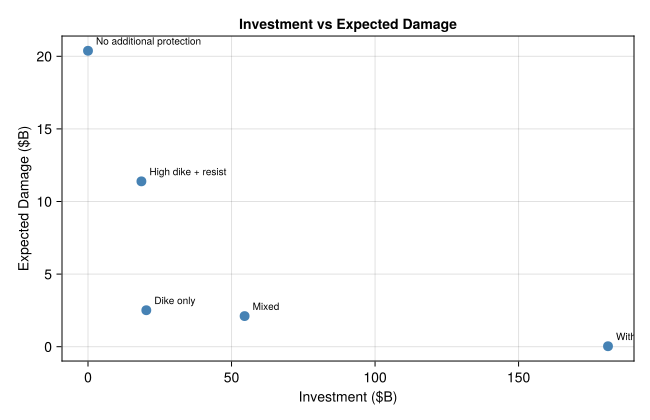
Points in the lower-left are cheapest overall (low investment + low damage). The ideal strategy minimizes the sum of investment and expected damage – but this depends on what you’re optimizing for. A risk-averse decision-maker might prefer a strategy with slightly higher expected cost but much lower tail risk.
So far we assumed a specific surge distribution. But in practice, the GEV parameters are uncertain – this is a key aspect of decision making under deep uncertainty.
Let’s see how our strategies perform under a heavier-tailed surge distribution (positive shape parameter):
scenario_heavy = EADScenario(;
    surge_loc=0.935,
    surge_scale=0.260,
    surge_shape=0.15,   # heavier tail: more extreme surges possible
    discount_rate=0.02,
    mean_sea_level=collect(range(0.0; step=0.01, length=n_years)),
)

scenarios_both = [scenario, scenario_heavy]
result_both = explore(config, scenarios_both, policy_list; progress=false)
YAXArray Dataset Shared Axes: None Variables with additional axes: Additional Axes: (↓ policy Sampled{Int64} 1:5 ForwardOrdered Regular Points, → scenario Sampled{Int64} 1:2 ForwardOrdered Regular Points) Variables: expected_damage, investment Additional Axes: (↓ policy Sampled{Int64} 1:5 ForwardOrdered Regular Points) Variables: policy_P, policy_a_frac, policy_b_frac, policy_r_frac, policy_w_frac Additional Axes: (↓ scenario Sampled{Int64} 1:2 ForwardOrdered Regular Points) Variables: scenario_discount_rate, scenario_mean_sea_level[100], scenario_mean_sea_level[10], scenario_mean_sea_level[11], scenario_mean_sea_level[12], scenario_mean_sea_level[13], scenario_mean_sea_level[14], scenario_mean_sea_level[15], scenario_mean_sea_level[16], scenario_mean_sea_level[17], scenario_mean_sea_level[18], scenario_mean_sea_level[19], scenario_mean_sea_level[1], scenario_mean_sea_level[20], scenario_mean_sea_level[21], scenario_mean_sea_level[22], scenario_mean_sea_level[23], scenario_mean_sea_level[24], scenario_mean_sea_level[25], scenario_mean_sea_level[26], scenario_mean_sea_level[27], scenario_mean_sea_level[28], scenario_mean_sea_level[29], scenario_mean_sea_level[2], scenario_mean_sea_level[30], scenario_mean_sea_level[31], scenario_mean_sea_level[32], scenario_mean_sea_level[33], scenario_mean_sea_level[34], scenario_mean_sea_level[35], scenario_mean_sea_level[36], scenario_mean_sea_level[37], scenario_mean_sea_level[38], scenario_mean_sea_level[39], scenario_mean_sea_level[3], scenario_mean_sea_level[40], scenario_mean_sea_level[41], scenario_mean_sea_level[42], scenario_mean_sea_level[43], scenario_mean_sea_level[44], scenario_mean_sea_level[45], scenario_mean_sea_level[46], scenario_mean_sea_level[47], scenario_mean_sea_level[48], scenario_mean_sea_level[49], scenario_mean_sea_level[4], scenario_mean_sea_level[50], scenario_mean_sea_level[51], scenario_mean_sea_level[52], scenario_mean_sea_level[53], scenario_mean_sea_level[54], scenario_mean_sea_level[55], scenario_mean_sea_level[56], scenario_mean_sea_level[57], scenario_mean_sea_level[58], scenario_mean_sea_level[59], scenario_mean_sea_level[5], scenario_mean_sea_level[60], scenario_mean_sea_level[61], scenario_mean_sea_level[62], scenario_mean_sea_level[63], scenario_mean_sea_level[64], scenario_mean_sea_level[65], scenario_mean_sea_level[66], scenario_mean_sea_level[67], scenario_mean_sea_level[68], scenario_mean_sea_level[69], scenario_mean_sea_level[6], scenario_mean_sea_level[70], scenario_mean_sea_level[71], scenario_mean_sea_level[72], scenario_mean_sea_level[73], scenario_mean_sea_level[74], scenario_mean_sea_level[75], scenario_mean_sea_level[76], scenario_mean_sea_level[77], scenario_mean_sea_level[78], scenario_mean_sea_level[79], scenario_mean_sea_level[7], scenario_mean_sea_level[80], scenario_mean_sea_level[81], scenario_mean_sea_level[82], scenario_mean_sea_level[83], scenario_mean_sea_level[84], scenario_mean_sea_level[85], scenario_mean_sea_level[86], scenario_mean_sea_level[87], scenario_mean_sea_level[88], scenario_mean_sea_level[89], scenario_mean_sea_level[8], scenario_mean_sea_level[90], scenario_mean_sea_level[91], scenario_mean_sea_level[92], scenario_mean_sea_level[93], scenario_mean_sea_level[94], scenario_mean_sea_level[95], scenario_mean_sea_level[96], scenario_mean_sea_level[97], scenario_mean_sea_level[98], scenario_mean_sea_level[99], scenario_mean_sea_level[9], scenario_surge_loc, scenario_surge_scale, scenario_surge_shape
fig = Figure(; size=(700, 420))
ax = Axis(fig[1, 1];
    xlabel="Investment (\$B)",
    ylabel="Expected Damage (\$B)",
    title="Strategy Performance Under Two Hazard Scenarios")

# Light-tailed scenario
inv_1 = result_both[:investment].data[:, 1] ./ 1e9
dmg_1 = result_both[:expected_damage].data[:, 1] ./ 1e9
scatter!(ax, inv_1, dmg_1; markersize=12, color=:steelblue, label="Baseline (shape=0.03)")

# Heavy-tailed scenario
inv_2 = result_both[:investment].data[:, 2] ./ 1e9
dmg_2 = result_both[:expected_damage].data[:, 2] ./ 1e9
scatter!(ax, inv_2, dmg_2; markersize=12, color=:firebrick, marker=:diamond, label="Frechet (shape=0.15)")

# Connect same policies across scenarios
for i in 1:length(policy_list)
    lines!(ax, [inv_1[i], inv_2[i]], [dmg_1[i], dmg_2[i]]; color=:gray70, linewidth=1)
    text!(ax, inv_2[i], dmg_2[i]; text=strategy_names[i], fontsize=9, offset=(8, 4))
end
axislegend(ax; position=:rt)
fig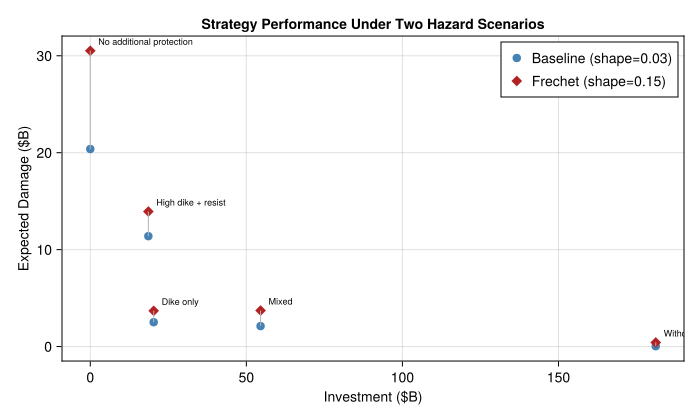
Investment costs stay the same across scenarios (they depend only on the policy), but expected damage shifts substantially. Strategies that looked adequate under a light-tailed hazard may leave the city badly exposed under heavier tails. This is why analyzing sensitivity to uncertain hazard parameters is essential before committing to a strategy.
You’ve completed a basic iCOW analysis. Here’s where to go from here: